
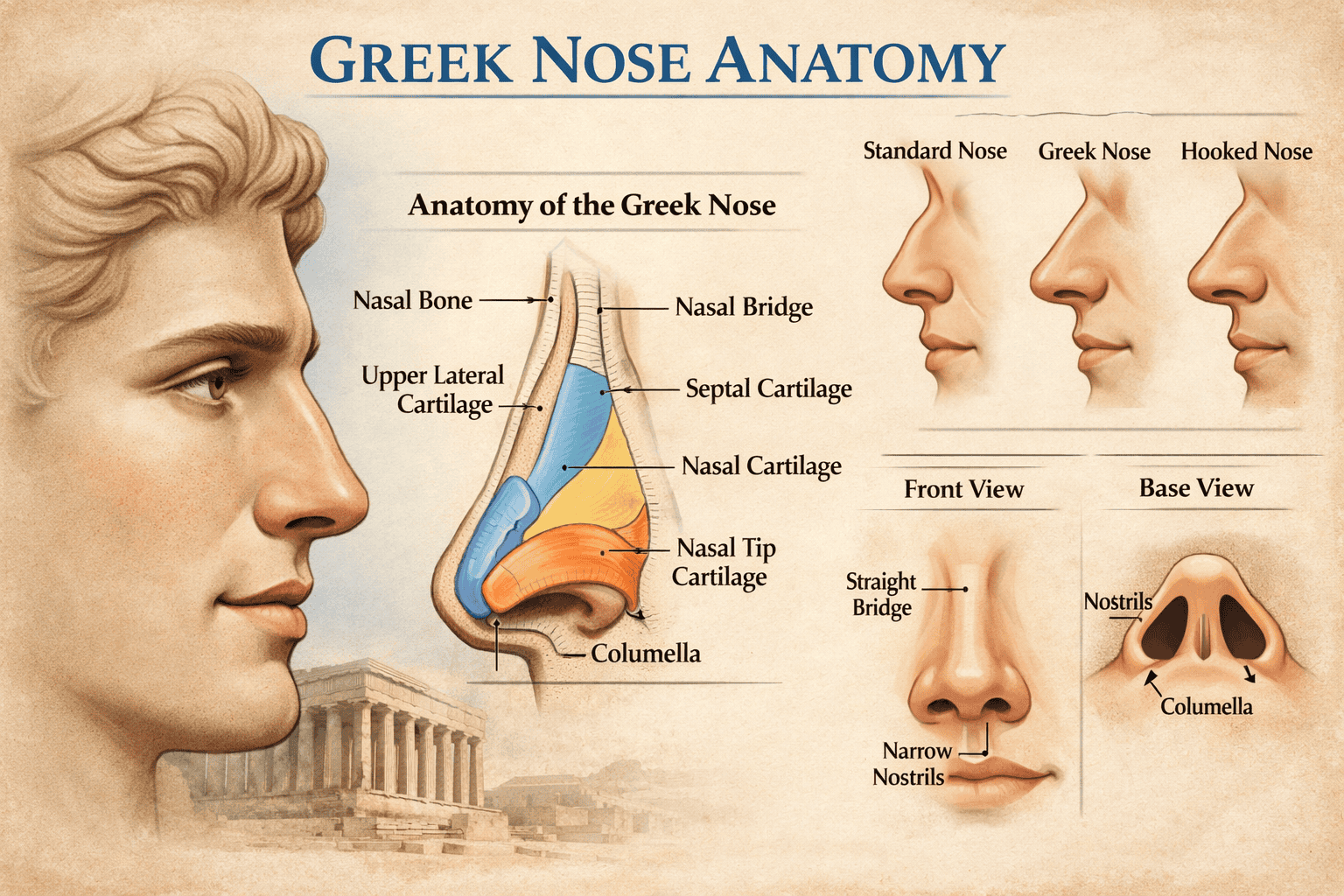
A Greek nose, sometimes called a straight nose, is generally recognized by a smooth, relatively straight nasal bridge with little or no visible hump or depression.
The name comes from the straight nasal profiles commonly represented in classical Greek sculpture. Today, however, “Greek nose” is an aesthetic description rather than a formal medical diagnosis.
Some people naturally appreciate this strong, balanced profile, while others consider subtle rhinoplasty for tip shape, projection, asymmetry or breathing concerns.
What Does a Greek Nose Look Like?
Common features associated with a Greek nose include:
- A straight nasal bridge
- Little or no dorsal hump
- Smooth transition from the upper bridge toward the tip
- Moderate nasal projection
- A relatively balanced side profile
- A tip that may be narrow, rounded or slightly projected
Not every Greek nose looks identical.
The bridge is the most important identifying characteristic. Tip width, nostril shape, skin thickness and overall nasal size can vary considerably from one person to another.
For a wider comparison, see Tabeebo’s guide to different nose shapes across ethnicities.
Greek Nose vs. Roman Nose
Greek and Roman noses are often confused because both can create prominent classical profiles.
The main difference is usually the shape of the nasal bridge.
A Greek nose generally has a:
Straight or nearly straight bridge
A Roman or aquiline nose more commonly has a:
Convex bridge or visible dorsal prominence
Real noses do not always fit perfectly into these categories, so a person may have characteristics of both.
For a detailed comparison, read our guide to the Roman or aquiline nose.
Greek Nose vs. Button Nose
A Greek nose usually appears longer and straighter in profile, while a button nose is generally described as smaller, more rounded at the tip and sometimes slightly upturned.
Neither shape is inherently better.
What looks harmonious depends on the relationship between the nose and the:
- Chin
- Forehead
- Cheeks
- Lips
- Jaw
- Overall facial proportions
Is a Greek Nose Attractive?
Greek noses have historically been associated with classical ideas of proportion and facial balance, particularly because of their straight profile.
But attractiveness is subjective.
Modern facial aesthetics increasingly emphasizes individual proportion rather than one ideal nose shape. A strong straight nose may suit one face extremely well, while another person may prefer softer projection or a more refined tip.
The aim of cosmetic treatment should therefore not be to create the same nose for everyone.
Greek Nose vs. Other Common Nose Shapes
Understanding how the Greek nose differs from other nasal types helps clarify surgical goals and expectations.
| Nose Shape | Key Difference from Greek Nose |
|---|---|
| Roman (Aquiline) | Prominent dorsal hump |
| Button Nose | Shorter, upturned tip |
| Nubian Nose | Wider base and nostrils |
| Fleshy Nose | Thick skin, rounded tip |
| Hawk Nose | Downward-curving bridge |
Unlike hump-based noses, the Greek nose often requires minimal structural alteration, making it ideal for conservative rhinoplasty approaches.
Why Some People with a Greek Nose Consider Rhinoplasty
Despite its aesthetic reputation, not everyone with a Greek nose feels fully confident about their appearance or nasal function. Common motivations for rhinoplasty include:
Aesthetic Reasons
-
Desire for a softer or more delicate look
-
Tip refinement (especially if bulbous or over-projected)
-
Minor asymmetry not visible from the profile
-
Better facial balance in frontal view
Functional Reasons
-
Nasal obstruction or breathing difficulty
-
Septal deviation (can exist even with a straight bridge)
-
History of trauma altering nasal alignment
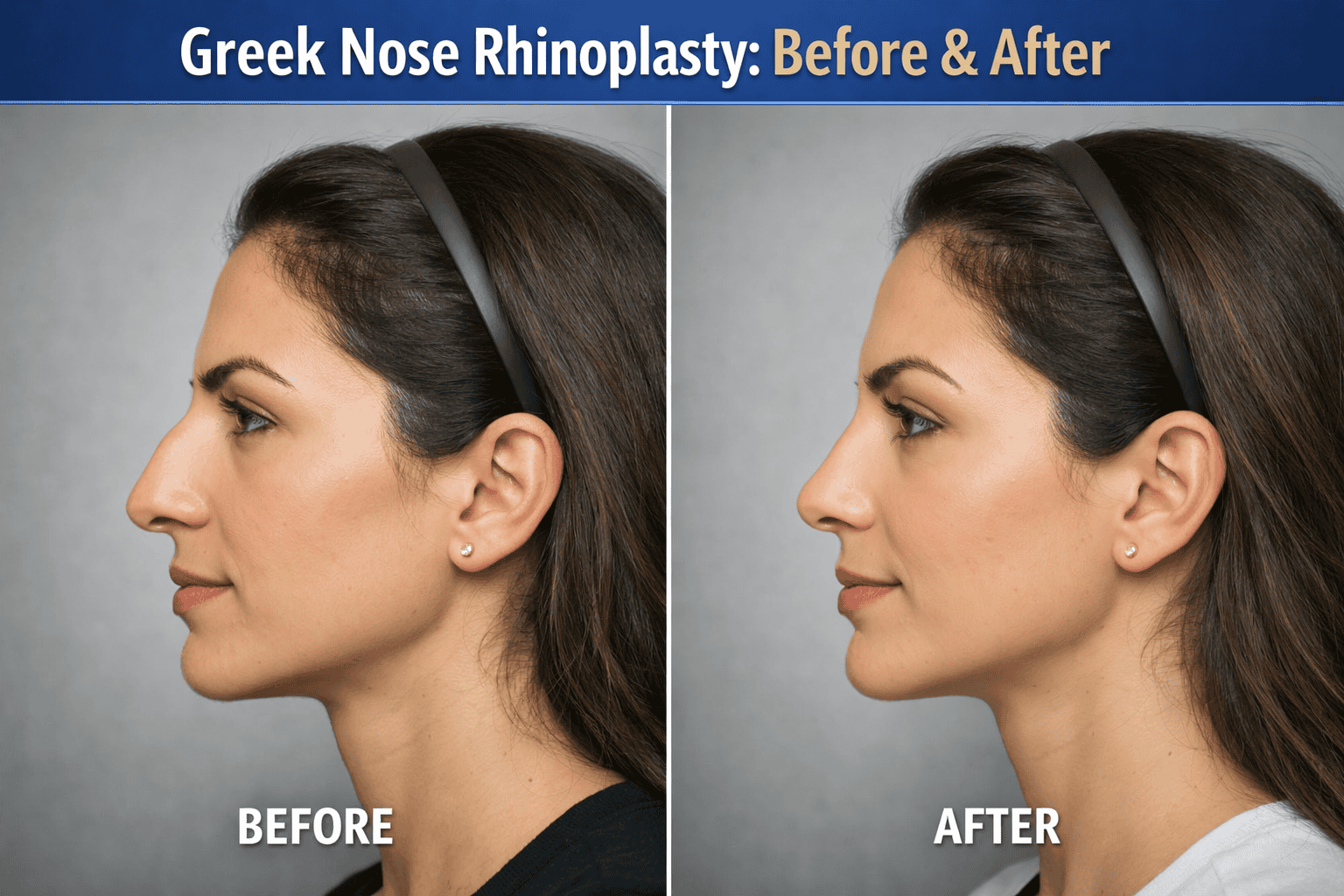
Importantly, rhinoplasty for a Greek nose is usually conservative, focusing on subtle refinement rather than dramatic reshaping.
Can Filler Change a Greek Nose?
Dermal filler can temporarily change certain nasal contours, but it cannot make a structurally large nose smaller because filler works by adding volume.
Nonsurgical rhinoplasty may be considered for selected minor contour irregularities, but it does not replace surgery when bone or cartilage needs to be reduced or repositioned.
Nasal filler also carries uncommon but potentially serious vascular risks, so treatment should be performed only by an appropriately qualified clinician.
Rhinoplasty for a Greek Nose
Rhinoplasty can modify the bone, cartilage and soft-tissue relationships of the nose.
Depending on the person’s anatomy, treatment may involve:
- Tip refinement
- Adjusting tip projection
- Correcting asymmetry
- Changing nasal width
- Treating septal deviation
- Improving nasal airflow
The American Society of Plastic Surgeons notes that rhinoplasty can be performed to improve facial proportion as well as breathing problems caused by structural abnormalities.
Should the Straight Bridge Be Preserved?
Often, yes—but not automatically.
If the straight dorsum already fits the person’s face, a surgeon may recommend preserving it while addressing another concern such as the tip or septum.
In other cases, the bridge itself may require adjustment.
The correct approach depends on anatomy rather than the label “Greek nose.”
Preservation vs. Structural Rhinoplasty
Preservation rhinoplasty can be useful in selected patients because it aims to retain more of the natural nasal framework.
However, it should not be described as the best technique for every Greek nose.
Structural, preservation, open or closed approaches can all be appropriate depending on:
- Existing anatomy
- Desired change
- Tip structure
- Septal problems
- Previous surgery
- Surgeon experience
There is no single technique that is best for every patient.
Can Rhinoplasty Improve Breathing?
Yes, when breathing problems are caused by structural abnormalities that can be corrected surgically.
A nose can appear completely straight externally while still having internal problems such as:
- Deviated septum
- Nasal valve narrowing
- Previous trauma
- Other airway abnormalities
Cosmetic and functional treatment may therefore be combined when appropriate.
Recovery and Risks
Early recovery after rhinoplasty commonly includes swelling, bruising and temporary congestion.
Much of the obvious swelling improves during the first few weeks, but refinement continues for months, particularly around the nasal tip.
Potential risks include:
- Bleeding
- Infection
- Changes in sensation
- Asymmetry
- Breathing difficulties
- Unsatisfactory appearance
- Need for revision surgery
Patients should discuss these possibilities during consultation rather than assuming that a conservative operation is risk-free.
How to Choose a Rhinoplasty Surgeon
If you are considering changing a Greek nose, look for a surgeon who evaluates the entire face rather than focusing only on making the nose smaller.
Important questions include:
- Which features actually need changing?
- Which features should be preserved?
- Will the straight bridge remain?
- Is nasal breathing normal?
- What result is realistic for my anatomy?
- What are the risks and recovery expectations?
If your research has reached the stage where you want to compare doctors, you can explore rhinoplasty specialists on Tabeebo and review provider profiles and locations before deciding whom to contact.
Frequently Asked Questions
What is a Greek nose?
A Greek nose is an informal description of a nose with a relatively straight bridge and little or no obvious hump or depression.
Is a Greek nose the same as a straight nose?
The terms are often used interchangeably, although real nasal anatomy varies and there is no formal medical category called a Greek nose.
What is the difference between a Greek and Roman nose?
A Greek nose is usually straighter along the bridge. A Roman or aquiline nose more commonly has a convex curve or dorsal prominence.
Does a Greek nose need rhinoplasty?
No. A Greek nose is a normal nasal shape. Surgery is considered only when the individual wants a cosmetic change or has a functional problem.
Can rhinoplasty preserve a Greek nose shape?
Yes. In appropriate patients, a surgeon may preserve the straight bridge while refining other areas such as the tip or correcting functional problems.
How long does rhinoplasty recovery take?
Visible swelling and bruising generally improve during the early weeks, while subtle refinement can continue for many months.
Final Thoughts
The Greek nose is best known for its relatively straight bridge and balanced side profile. It is a natural anatomical variation, not a condition that requires treatment.
For someone considering rhinoplasty, the goal should be to address specific concerns while preserving features that already complement the face.
You can continue comparing nasal shapes through Tabeebo’s guides to different nose shapes, the Roman or aquiline nose and the button nose.
If you are considering treatment:
Explore rhinoplasty specialists on Tabeebo →
This article provides general educational information and does not replace individual medical advice.