
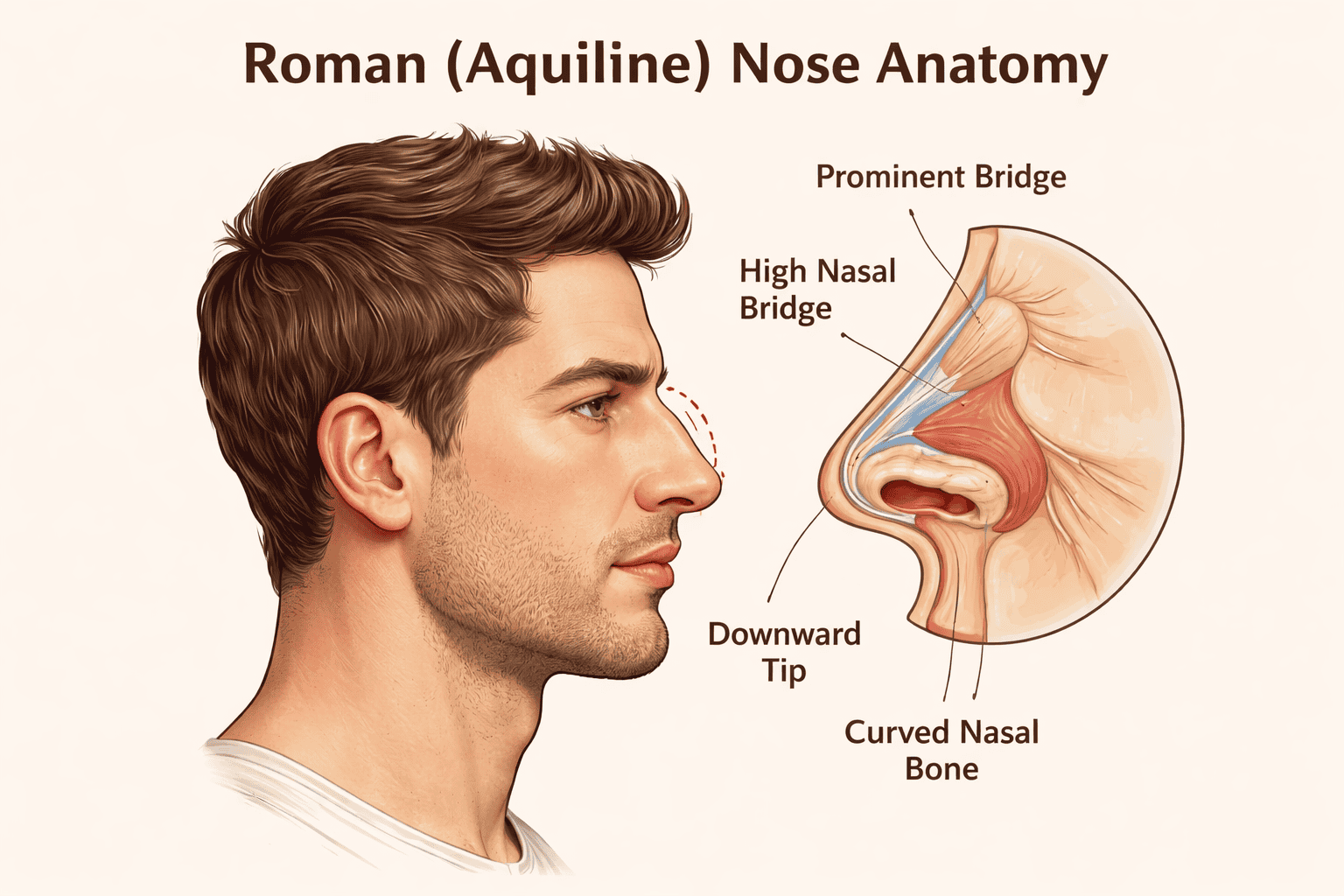
An aquiline nose, often called a Roman nose, is generally recognized by a prominent nasal bridge that creates a straight-to-convex profile when viewed from the side. In some people, this appears as a subtle outward curve; in others, the bridge forms a more noticeable dorsal hump.
Both terms are widely used to describe a strong nasal profile, although neither is a formal medical diagnosis. Surgeons assess the nose using specific anatomical features such as the nasal bridge, dorsum, tip, projection, septum, cartilage and relationship to the rest of the face.
Some people consider an aquiline nose an important part of their identity and have no desire to change it. Others explore rhinoplasty because they would prefer a straighter profile, less prominent bridge or different balance between the nose and other facial features.
This guide explains what a Roman or aquiline nose looks like, what the terms mean, how this nose shape differs from Greek and other nasal types, whether it is genetic, and what surgical or nonsurgical treatments can realistically change.
What Is an Aquiline Nose?
The term aquiline describes a nose with a noticeable curve or prominence along the bridge.
The word is derived from the Latin association with an eagle, reflecting the resemblance between a curved nasal profile and an eagle’s beak. Merriam-Webster’s definition of aquiline similarly describes the term as commonly referring to a broadly curved or slightly hooked nose.
Typical characteristics may include:
- A prominent nasal bridge
- A straight or convex dorsal profile
- A visible dorsal hump in some people
- Moderate to strong nasal projection
- A relatively defined side profile
- A tip that may be straight, projected or slightly downward-oriented
Not every aquiline nose has the same degree of curvature.
Some are only mildly convex, while others have a much more pronounced dorsal hump.
What Is a Roman Nose?
“Roman nose” is another traditional descriptive term for a prominent nasal profile.
In everyday use, Roman nose and aquiline nose frequently overlap, which is why the terms are often used interchangeably.
However, the descriptions are not perfectly standardized.
A Roman nose may be described primarily as having a high or prominent bridge, whereas “aquiline” more strongly emphasizes the curved or slightly hooked appearance of the profile.
In practice, someone searching for either term is usually referring to the same general family of nasal features:
a strong, prominent bridge with a straight-to-convex side profile.
These are descriptive labels rather than medical categories.
For a wider comparison of nasal forms, see Tabeebo’s guide to different nose shapes across ethnicities.
What Does a Roman Nose Look Like?
From the side, the bridge is usually the most noticeable feature.
Common characteristics can include:
Prominent Nasal Bridge
The upper and middle portions of the nose project noticeably from the face.
Convex Profile
Instead of creating a completely straight line from the nasal root toward the tip, the bridge may curve slightly outward.
Dorsal Hump
Some Roman or aquiline noses have a visible prominence composed of bone, cartilage or a combination of both.
Strong Projection
The nose may project farther forward than some other nasal shapes, giving it a distinctive profile.
Variable Nasal Tip
A Roman nose does not require one particular tip shape.
The tip may be:
- Straight
- Projected
- Slightly downward-pointing
- Rounded
- Narrow
- Broad
For this reason, two people can both have Roman noses while looking considerably different.
Is a Roman Nose the Same as a Dorsal Hump?
Not necessarily.
A dorsal hump refers specifically to a raised area along the bridge of the nose.
An aquiline or Roman nose is a broader aesthetic description.
Someone may have:
- A generally convex bridge without a sharply defined hump
- A prominent bony hump
- A cartilaginous prominence
- A combination of bone and cartilage
A surgeon evaluating a dorsal hump examines where the prominence begins, its composition and how it relates to the nasal tip and facial profile.
This distinction becomes particularly important when planning rhinoplasty.
Roman Nose vs. Greek Nose
The Roman nose and Greek nose are frequently confused because both are associated with prominent nasal bridges and classical facial profiles.
The main difference is usually the shape of the bridge.
A Greek nose is generally associated with a straighter dorsal line.
A Roman or aquiline nose is more likely to display outward convexity or a visible hump.
In simplified terms:
Greek nose: relatively straight bridge
Roman/Aquiline nose: more convex or curved bridge
But real noses exist on a spectrum, and a person may have characteristics associated with more than one descriptive category.
You can compare them in greater detail in Tabeebo’s guide to the Greek nose and its characteristics.
Roman Nose vs. Button Nose
These two nose shapes usually create very different profiles.
A button nose is generally described as:
- Relatively compact
- Softly rounded at the tip
- Sometimes slightly upturned
A Roman nose typically has:
- Greater bridge prominence
- Stronger projection
- A straighter-to-convex profile
Neither shape is inherently more attractive.
They simply represent different combinations of nasal anatomy and facial proportions.
Read more in Tabeebo’s guide to button nose shape, characteristics and rhinoplasty.
Is a Roman Nose the Same as a Hooked Nose?
The descriptions can overlap, but they are not always identical.
“Hooked nose” generally emphasizes a downward-curving or hook-like appearance, particularly toward the lower bridge or tip.
An aquiline nose can appear gently curved without looking strongly hooked.
Therefore, an individual might reasonably describe their nose as:
- Aquiline but not strongly hooked
- Roman with a mild dorsal hump
- Prominent and convex
- Hooked with downward tip rotation
Precise anatomical description is more useful than relying only on labels.
Is a Roman or Aquiline Nose Genetic?
Genetics plays an important role in nasal and facial morphology.
Features including nasal width, bridge height, projection and tip shape are influenced by multiple genes and developmental factors.
There is no single “Roman nose gene.”
Instead, different inherited characteristics combine to produce the final appearance of the nose.
This explains why several members of the same family may have similar nasal profiles while still differing in:
- Bridge height
- Hump prominence
- Nasal width
- Tip rotation
- Overall size
The aquiline appearance can therefore occur naturally across generations without producing identical noses.
What Ethnicity Has an Aquiline Nose?
Aquiline noses occur in many populations.
They have historically been associated with various Mediterranean, European, Middle Eastern and other populations, but it would be inaccurate to describe the feature as belonging exclusively to one ethnicity.
Human facial anatomy varies significantly both between populations and within the same population.
A particular nasal shape should therefore not be used to determine someone’s ethnicity, ancestry, personality or background.
For a broader discussion of population-level nasal variation, visit Tabeebo’s guide to nose shapes across different ethnicities.
What Does a Roman Nose Mean?
Historically, prominent noses have appeared in sculpture, portraiture, literature and cultural symbolism.
Aquiline noses have sometimes been associated with qualities such as:
- Strength
- Authority
- Nobility
- Leadership
- Individuality
However, these are cultural associations, not scientific conclusions.
Nose shape does not determine intelligence, personality, leadership ability or character.
Older traditions of physiognomy attempted to connect facial features with personality traits, but such assumptions should not be treated as reliable science.
Today, the Roman nose is better understood simply as one of many naturally occurring facial forms.
Are Roman Noses Attractive?
Attractiveness is subjective.
Some people particularly admire a prominent aquiline profile because it creates a distinctive facial identity. Others personally prefer straighter, smaller or more upturned noses.
The appearance of the nose also cannot be evaluated independently from the rest of the face.
Aesthetic balance can be influenced by the relationship between the nose and:
- Chin
- Forehead
- Lips
- Cheekbones
- Jaw
- Overall facial length and width
A prominent nose may look highly harmonious on one face and disproportionately dominant on another.
This is one reason rhinoplasty planning should focus on facial proportion rather than reducing every prominent nose toward the same shape.
Should a Roman Nose Be Changed?
There is no medical reason to change a Roman or aquiline nose simply because of its shape.
It is a normal anatomical variation.
Some people strongly identify with a prominent nasal profile and consider it an important part of their appearance.
Others may consider treatment because they are concerned about:
- A prominent dorsal hump
- An excessively projecting bridge
- A drooping tip
- Facial imbalance in profile
- Nasal asymmetry
- Previous injury
- Breathing difficulties
Cosmetic preference alone can be a legitimate reason to explore treatment, but the decision should be based on personal goals rather than pressure from trends or other people’s opinions.
Can Filler Hide an Aquiline Nose?
In selected cases, dermal filler can camouflage the appearance of a mild dorsal hump.
Instead of removing the hump, filler is placed strategically around it to create the visual impression of a straighter profile.
This is often called nonsurgical rhinoplasty or liquid rhinoplasty.
Filler may sometimes help with:
- Mild dorsal irregularities
- Small central humps
- Selected asymmetries
- Profile contouring
But filler has an important limitation:
it adds volume rather than removing tissue.
The American Society of Plastic Surgeons explains that filler can visually smooth a dorsal hump, but it cannot actually reduce the size of the nose. Read the ASPS discussion of nonsurgical rhinoplasty.
For someone with an already prominent or highly projected Roman nose, adding volume may not create the desired result.
Is Nose Filler Safe?
Nasal filler is not risk-free.
The nose has a complex vascular anatomy, and complications can include vascular injury, tissue damage and, rarely, visual complications.
Cleveland Clinic notes that nonsurgical rhinoplasty requires particular caution because of the nose’s blood supply and proximity to the eyes.
Anyone considering nasal filler should therefore be assessed by an appropriately qualified healthcare professional with specific experience in facial anatomy and filler complications.
Can Rhinoplasty Change a Roman or Aquiline Nose?
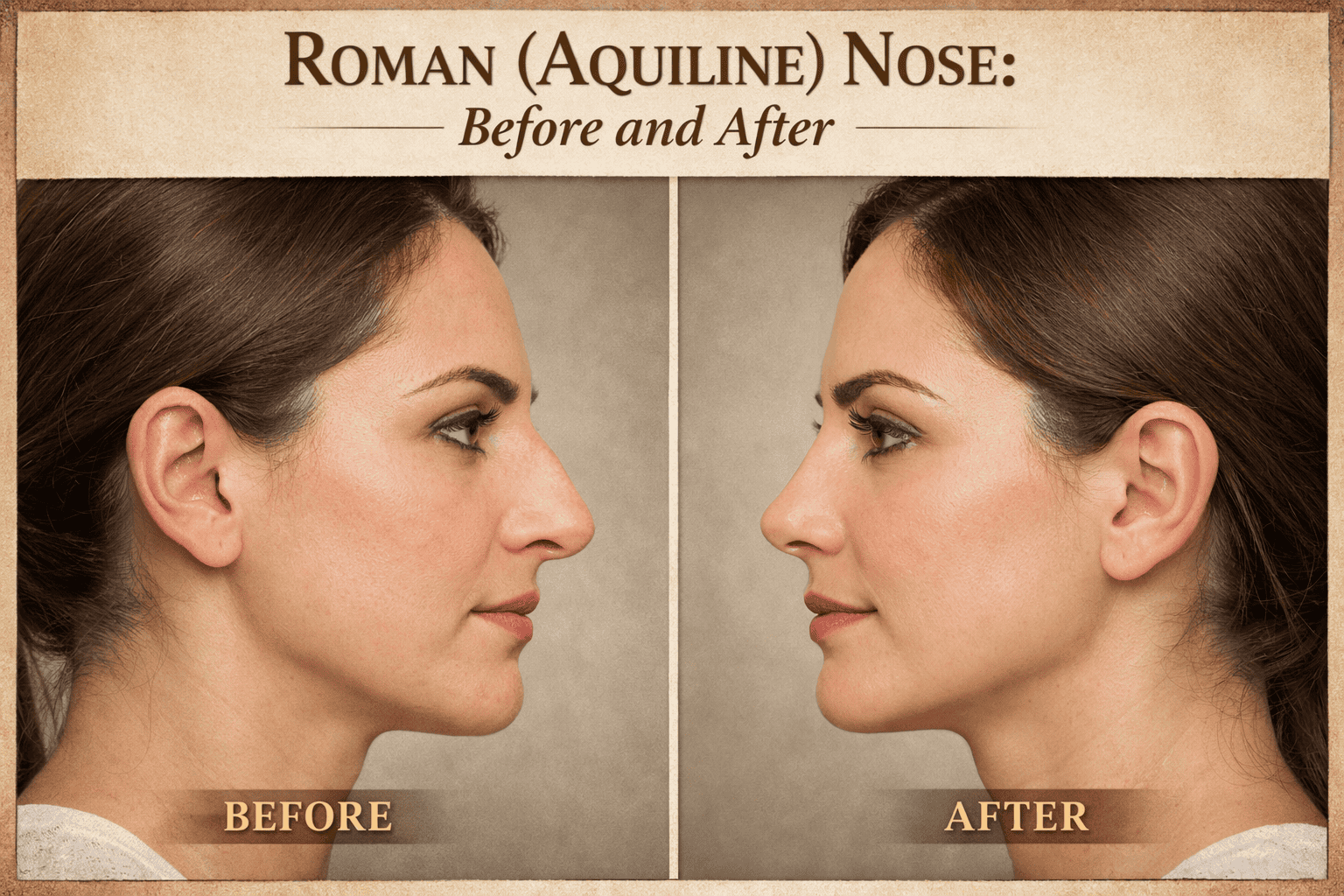
Yes. Rhinoplasty can permanently alter the bone, cartilage and proportions that contribute to a prominent or convex nasal profile.
The operation is not the same for every Roman nose.
Depending on the anatomy and goals, treatment may involve:
- Reducing a dorsal hump
- Reshaping nasal bones
- Adjusting cartilage
- Changing tip projection
- Changing tip rotation
- Refining nasal width
- Correcting asymmetry
- Addressing septal or airway problems when present
The goal should not automatically be to remove every trace of the aquiline profile.
Some patients prefer subtle refinement while preserving the strong characteristics of their natural nose.
Thinking About Rhinoplasty?
If you are researching Roman or aquiline noses because you are considering changing your own profile, the most useful next step is determining which changes are appropriate for your anatomy rather than choosing a generic nose shape.
You can explore rhinoplasty specialists on Tabeebo and compare provider profiles by location and available profile information before deciding whom you would like to contact.
Dorsal Hump Reduction
For patients primarily concerned about a prominent bridge, treatment may include reduction or repositioning of the nasal dorsum.
The hump can contain:
- Bone
- Cartilage
- Both bone and cartilage
Changing the bridge also affects the relationship between the dorsum and nasal tip, so hump reduction cannot always be planned in isolation.
Excessive reduction can result in an unnaturally flat or over-reduced profile and may affect structural support.
This is one reason modern rhinoplasty emphasizes careful preservation or reconstruction of nasal anatomy.
Preservation Rhinoplasty for an Aquiline Nose
Preservation rhinoplasty refers to a group of techniques designed to modify the nasal dorsum while preserving more of its natural surface anatomy.
Instead of simply removing the top of the dorsal hump, selected preservation techniques lower or reposition parts of the nasal framework.
Potential objectives include:
- Maintaining natural dorsal aesthetic lines
- Reducing disruption to selected structures
- Preserving continuity of the nasal bridge
However, preservation rhinoplasty is not automatically the best technique for every Roman nose.
Recent reviews suggest that preservation approaches can produce good functional and aesthetic outcomes in appropriately selected patients, while patient selection and surgical anatomy remain important. PubMed research on preservation rhinoplasty.
Large humps, complex asymmetry, previous surgery and other anatomical features may require different approaches.
Structural or Reduction Rhinoplasty
Traditional structural approaches may be more suitable when the surgeon needs greater control over:
- A substantial dorsal hump
- Nasal width
- Tip support
- Significant asymmetry
- Weak or altered cartilage
- Functional problems
These procedures may involve controlled reduction followed by reconstruction or reinforcement of important nasal structures.
The choice between preservation and structural approaches should therefore be based on anatomy and surgical objectives—not marketing terminology.
Open vs. Closed Rhinoplasty
Roman nose surgery can potentially be performed using either an open or closed approach.
Open Rhinoplasty
The open approach gives the surgeon broad access to the nasal framework through internal incisions plus a small incision across the columella.
It may be useful when substantial structural work or complex tip modification is needed.
Closed Rhinoplasty
Closed rhinoplasty uses incisions placed inside the nostrils.
It may be suitable for selected patients where the required changes can be accomplished without external exposure.
Neither approach is universally superior.
The best method depends on:
- Anatomy
- Complexity of the operation
- Previous surgery
- Surgical goals
- Surgeon’s experience and technique
What About Ultrasonic Rhinoplasty?
Some surgeons use piezoelectric or ultrasonic instruments to reshape nasal bone.
Instead of conventional mechanical bone-cutting tools, ultrasonic systems use high-frequency vibration to make controlled changes to bone.
The American Society of Plastic Surgeons provides an overview of ultrasonic rhinoplasty.
The technology can be useful in selected cases, but it does not replace the importance of appropriate surgical planning and experience.
A sophisticated tool cannot compensate for an unsuitable surgical plan.
Can Rhinoplasty Improve Breathing?
Sometimes—but only when an actual functional problem is present and appropriately treated.
A visible dorsal hump by itself does not automatically mean a person has breathing difficulty.
Breathing problems may instead be related to conditions such as:
- Deviated nasal septum
- Nasal valve narrowing
- Previous trauma
- Other structural abnormalities
When cosmetic and functional concerns occur together, surgeons may address both during the same operation.
A proper consultation should therefore assess nasal breathing as well as appearance.
Risks of Roman Nose Rhinoplasty
Rhinoplasty is surgery and carries potential complications.
These may include:
- Bleeding
- Infection
- Swelling
- Scarring
- Changes in sensation
- Nasal asymmetry
- Septal problems
- Breathing difficulty
- Unsatisfactory appearance
- Need for additional surgery
Cleveland Clinic’s rhinoplasty guide provides further information about potential risks and recovery.
One of the specific aesthetic risks when reducing a prominent nasal bridge is over-reduction.
Removing too much of the dorsum may eliminate facial character, create an unnatural profile or require reconstructive work.
The objective should therefore be proportional refinement rather than automatically creating the smallest possible nose.
Roman Nose Rhinoplasty Recovery
Early recovery commonly involves:
- Swelling
- Bruising
- Nasal congestion
- Tenderness
Much of the obvious bruising and swelling improves during the first several weeks, but the nose continues to change much longer.
Tip swelling and subtle contour changes may take months to settle.
Final refinement after rhinoplasty may take approximately a year or sometimes longer, depending on the operation and individual healing.
Patients should therefore avoid judging the final result too early.
How to Choose a Surgeon for Aquiline Nose Rhinoplasty
The shape itself does not require a special marketing label such as a “Roman nose surgeon.”
What matters is whether the surgeon has relevant experience with:
- Dorsal hump management
- Structural rhinoplasty
- Preservation techniques when appropriate
- Tip surgery
- Functional nasal assessment
- Different facial and nasal anatomies
Verify Credentials
Review the doctor’s:
- Medical license
- Relevant surgical training
- Specialty
- Professional background
Examine Comparable Results
Look for before-and-after photographs involving patients with prominent or convex nasal profiles.
Consider whether results appear:
- Natural
- Proportional
- Consistent from multiple angles
- Appropriate for different facial structures
Ask What Will Be Preserved
A useful consultation should address not only what the surgeon proposes to remove, but also what should remain.
Ask:
- How much of the hump would be changed?
- Will the tip also require modification?
- How will nasal support be maintained?
- Is preservation rhinoplasty appropriate in this case?
- Are there functional issues?
- What changes are realistic?
Compare Qualified Providers
When you reach the stage of comparing surgeons rather than only researching nose shapes, you can browse rhinoplasty specialists on Tabeebo and explore provider profiles, locations and available professional information.
Frequently Asked Questions About Roman and Aquiline Noses
What is an aquiline nose?
An aquiline nose is generally characterized by a prominent bridge with a straight-to-convex or slightly curved profile. The term refers to the resemblance of the curve to an eagle’s beak.
What is a Roman nose?
Roman nose is a traditional descriptive term for a nose with a prominent or high bridge. It frequently overlaps with the term aquiline nose.
Are Roman and aquiline noses the same?
The terms are commonly used interchangeably, although “aquiline” more specifically emphasizes curvature and “Roman” may emphasize prominence of the bridge. Neither term represents a formal medical classification.
What does a Roman nose look like?
A Roman nose usually has a prominent bridge and strong side profile. Some noses have a visible dorsal hump or convex curve, while others are primarily distinguished by bridge height and projection.
Is a Roman nose attractive?
Many people find prominent noses attractive, while others prefer different shapes. Attractiveness is subjective and depends on personal preference and the relationship between the nose and the rest of the face.
Is an aquiline nose genetic?
Genetics contributes strongly to nasal morphology. Many genes and developmental factors influence the bridge, width, projection and tip, so there is no single gene responsible for an aquiline nose.
What ethnicity has Roman noses?
Aquiline and Roman-like nasal characteristics occur across many populations and should not be assigned exclusively to one ethnicity.
What is the difference between a Roman nose and a Greek nose?
A Greek nose is generally described as having a straighter bridge, while a Roman or aquiline nose more often has a convex profile or dorsal prominence.
Can nose filler remove a Roman nose?
No. Filler cannot remove a dorsal hump because it adds volume. In selected patients, it may camouflage a mild hump by filling adjacent areas and creating the appearance of a straighter profile.
Can rhinoplasty remove a dorsal hump?
Rhinoplasty can reduce or reposition structures that contribute to a dorsal hump. The appropriate technique depends on the size and composition of the hump, nasal anatomy and treatment goals.
Is preservation rhinoplasty better for an aquiline nose?
Not necessarily. Preservation techniques can be useful for selected dorsal humps, but they are not appropriate for every patient. Structural anatomy, hump size, previous surgery and surgical objectives determine the best approach.
Does Roman nose rhinoplasty change your identity?
It can if the nose is changed too aggressively. Many patients prefer subtle refinement that preserves distinctive facial characteristics rather than completely eliminating them.
How long does Roman nose rhinoplasty take to heal?
Much of the early swelling and bruising improves within weeks, but refinement continues for months. The final result may take about a year or longer to fully settle.
Final Thoughts
The Roman or aquiline nose is a naturally occurring nasal shape characterized mainly by a prominent bridge and, in many people, a straight-to-convex profile.
It does not indicate personality, intelligence, ethnicity or character, and there is no medical reason to change it simply because it differs from current beauty trends.
For people who do want cosmetic refinement, modern rhinoplasty offers several approaches to modifying a dorsal hump or nasal projection while preserving structural support and facial identity.
If you are still learning about nose shapes, explore Tabeebo’s guides to different nose shapes, the Greek nose, or the button nose.
If your interest has progressed from research to considering treatment, you can:
Explore rhinoplasty specialists on Tabeebo →
Compare provider profiles and locations, then discuss your anatomy, functional concerns and treatment goals directly with an appropriately qualified healthcare professional.
This article is intended for general educational purposes and does not replace individual medical advice, diagnosis or treatment.