
7 Best Alternatives to Dental Implants (Pros, Cons & Cost Comparison Guide)
Dental implants are often considered the gold standard for replacing missing teeth. They are durable, stable, and natural-looking. However, not […]
A bulbous nasal tip is one of the most frequent concerns among rhinoplasty patients—and one of the most misunderstood. Unlike […]

A bulbous nasal tip is one of the most frequent concerns among rhinoplasty patients—and one of the most misunderstood. Unlike a dorsal hump or nasal deviation, a bulbous tip cannot be “shaved down.” Successful correction requires a deep understanding of nasal anatomy, skin behavior, and long-term structural support.
Modern rhinoplasty no longer focuses on making the nose smaller. Instead, bulbous nose rhinoplasty is about refinement, proportion, and durability, ensuring that results remain natural years after surgery, not just in early postoperative photos.
This article explains what a bulbous nose is, why it occurs, and how skilled surgeons safely refine the nasal tip using contemporary techniques.
A bulbous nose refers to a nose with a rounded, wide, or poorly defined nasal tip, typically affecting the lower third of the nose. The bulbous appearance may be present at rest or become more noticeable when smiling.
Common features include:
A round or ball-shaped nasal tip
Poor separation between the tip and the nostrils
A wide tip on frontal view
Thick or sebaceous skin
Importantly, a bulbous nose does not necessarily mean a large nose overall. Many patients have a straight or narrow nasal bridge but feel the tip looks heavy or undefined.
The nasal tip is one of the most complex structures in facial anatomy. Its shape depends on the interaction between:
Lower lateral (alar) cartilages
Skin thickness and soft tissue envelope
Septal support
Muscle activity
In bulbous noses, surgeons commonly encounter:
Wide or convex lower lateral cartilages
Excess soft tissue between cartilage and skin
Thick skin that blunts definition
Weak structural support allowing the tip to spread rather than project
This is why over-resection of cartilage almost always leads to failure in bulbous nose rhinoplasty.
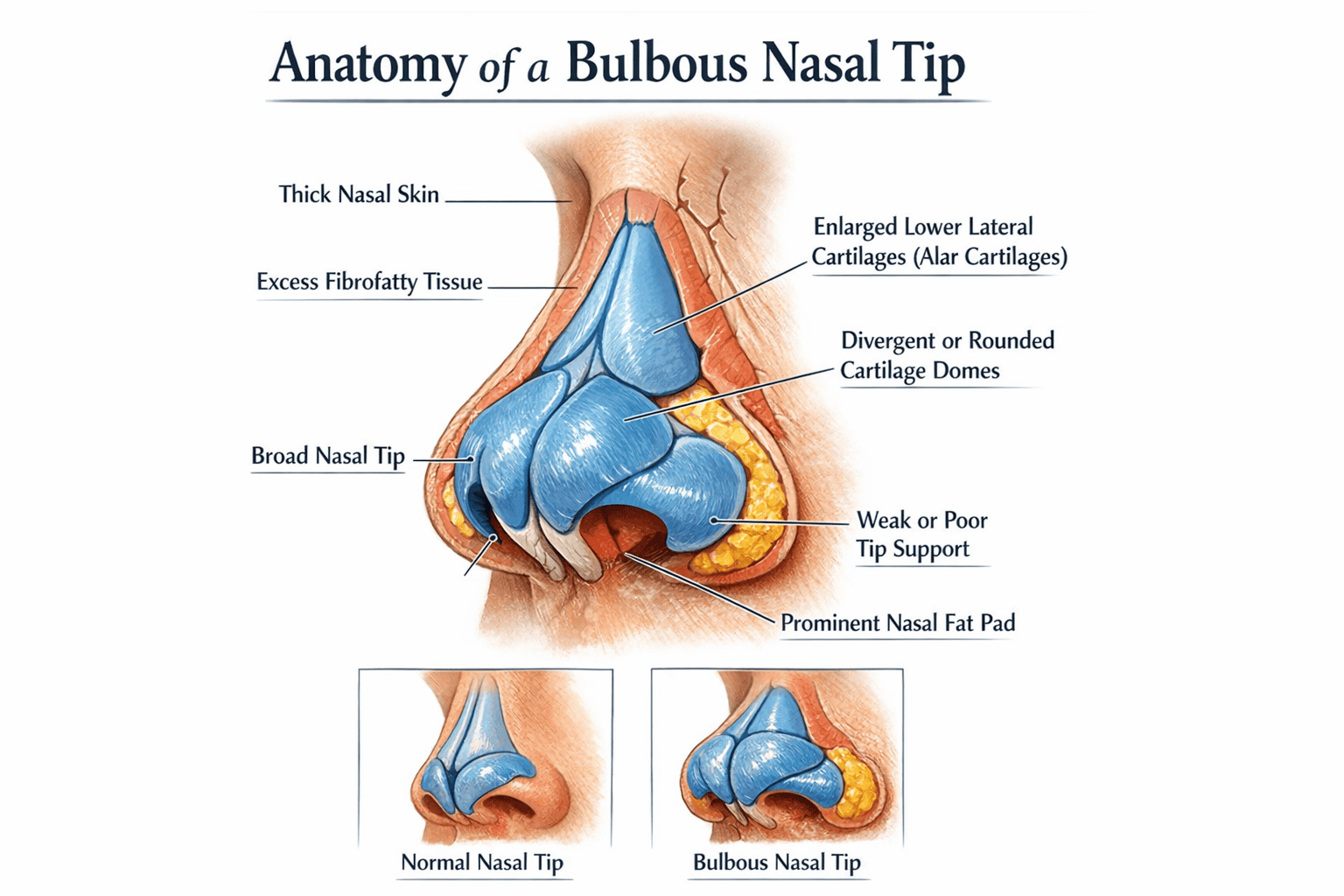
Bulbous nasal tips are more common in certain populations due to cartilage shape and skin thickness. Nasal anatomy varies significantly across ethnicities, which is why surgical planning must be individualized.
For a broader perspective, see:
👉 What are the different nose shapes across ethnicities?
Thick skin limits visible definition and contracts slowly after surgery, making refinement more challenging.
When cartilages lack strength or are positioned too far apart, the tip appears broad and flat.
Some patients have a normal tip at rest, but muscular activity causes the tip to widen or droop when smiling.
Bulbous nose rhinoplasty may be appropriate when:
The nasal tip lacks definition despite overall facial harmony
The tip appears disproportionately wide
The bulbous shape affects facial balance or confidence
Non-surgical options cannot address the underlying structure
Surgery should never be trend-driven. The goal is harmony, not exaggeration.
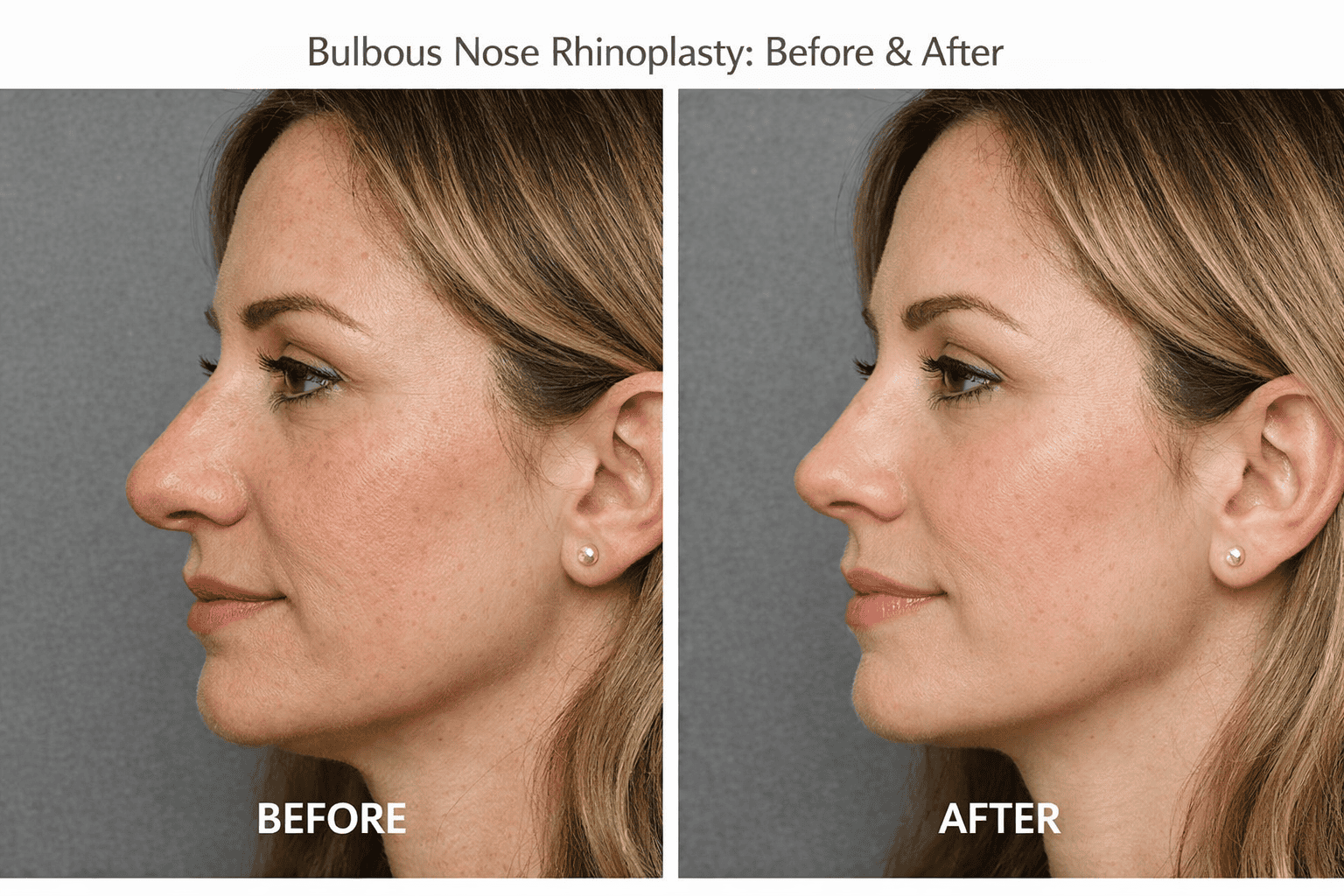
Precise suturing reshapes cartilage without removing critical support.
Septal or conchal grafts are often used to:
Improve projection
Strengthen tip support
Prevent long-term collapse
Excessive rotation leads to unnatural results. Modern rhinoplasty emphasizes balance.
Skin is never thinned. Surgeons work beneath it, anticipating long-term settling.
Bulbous noses often require an open approach for precision and stability.
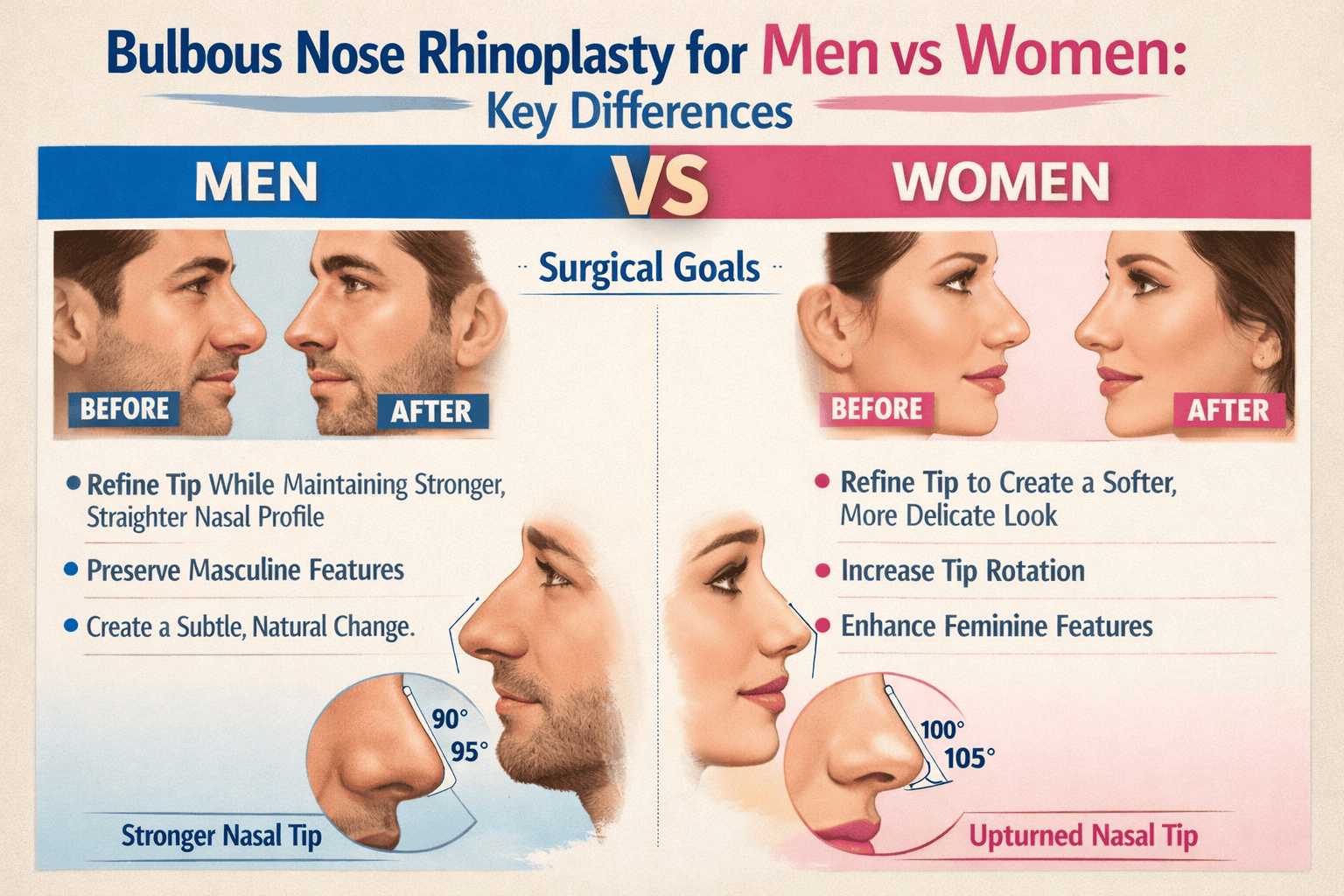
While the underlying anatomy may be similar, aesthetic goals differ significantly between men and women.
Slightly more tip refinement is acceptable
Softer contours and gentle rotation are often desired
Over-definition can still look unnatural
Tip refinement must preserve strength and projection
Over-narrowing feminizes the nose
Straighter angles and stronger support are critical
Experienced surgeons tailor techniques based on gender, facial proportions, and cultural expectations.
Thick skin is one of the greatest challenges in nasal tip surgery.
Limited visible definition
Prolonged swelling
Higher risk of scar tissue formation
Strong structural grafting
Conservative refinement
Patience during healing (results may take 12–18 months)
Surgeons who promise dramatic changes in thick-skinned noses often create long-term problems.
Many failed bulbous nose surgeries result from predictable errors:
Over-resection of cartilage
Lack of structural grafts
Excessive tip rotation
Ignoring long-term scar contraction
Prioritizing early appearance over durability
Modern rhinoplasty avoids these mistakes by focusing on support, not reduction.
A nose may appear worse post-surgery due to:
Loss of tip support
Progressive scar contraction
Over-shortening of the nose
Poor planning for thick skin
These issues often worsen months or years later, highlighting why long-term thinking is essential.
Gradual refinement over time
Longer healing in thick-skinned noses
Subtle, natural improvement rather than dramatic change
Persistent swelling
Asymmetry
Under- or over-correction
Need for revision surgery
Risk is minimized by choosing an experienced surgeon.
The nasal tip is the most complex part of rhinoplasty. Surgeon selection is more important than technique selection.
Look for:
Experience with bulbous and thick-skinned noses
Structural rather than reductive philosophy
Long-term follow-up cases
You can explore verified specialists experienced in nasal tip refinement through Tabeebo’s rhinoplasty surgeon directory:
👉 Find experienced rhinoplasty surgeons on Tabeebo
Bulbous nose rhinoplasty is not about making the nose smaller—it’s about balance, structure, and longevity. When anatomy, skin type, and facial harmony are respected, results remain natural for years.
Patients who understand these principles—and choose surgeons accordingly—achieve outcomes that age well, rather than looking “operated” over time.
Rohrich RJ, et al. Nasal Tip Refinement: Anatomy and Techniques. Plastic and Reconstructive Surgery.
Toriumi DM. Structural Rhinoplasty. Facial Plastic Surgery Clinics of North America.
Daniel RK. Rhinoplasty: An Atlas of Surgical Techniques.
American Society of Plastic Surgeons (ASPS). Rhinoplasty Guidelines.
PubMed: Long-term outcomes of cartilage-based tip refinement in rhinoplasty.
Dental implants are often considered the gold standard for replacing missing teeth. They are durable, stable, and natural-looking. However, not […]

An upturned nose, often referred to as a celestial nose, is one of the most recognizable and debated nasal shapes […]

The Roman nose—also known as the aquiline nose—is one of the most recognizable and historically significant nose shapes. Characterized by […]

A fleshy nose is one of the most misunderstood nose types in facial aesthetics. Many people with this nasal structure […]

The Greek nose is one of the most recognizable and historically admired nose shapes in the world. Often associated with […]

A crooked nose is one of the most common facial concerns seen in both cosmetic and functional rhinoplasty consultations. While […]
Summary
