Greek Nose: Characteristics, Aesthetic Appeal, and the Best Rhinoplasty Techniques

The Greek nose is one of the most recognizable and historically admired nose shapes in the world. Often associated with […]

Attractive female Greek Nose

The Greek nose is one of the most recognizable and historically admired nose shapes in the world. Often associated with balance, symmetry, and classical beauty, this nasal form has been depicted in ancient sculptures, artworks, and modern facial analysis alike. While many people naturally embrace the Greek nose as an aesthetic ideal, others explore rhinoplasty to subtly refine or preserve its defining features while improving harmony with the rest of the face.

In this comprehensive guide, we explore what defines a Greek nose, why it is considered attractive, how it differs from other nose shapes, and what modern rhinoplasty techniques can achieve—while maintaining natural and culturally respectful results.

What Is a Greek Nose?

A Greek nose is characterized by a straight nasal bridge that runs in a smooth line from the forehead to the tip of the nose, without a dorsal hump or indentation. The nasal bones and cartilage align evenly, creating a profile that appears linear and proportionate.

Key Characteristics of a Greek Nose

  • Straight nasal bridge from radix to tip

  • No visible hump or concavity

  • Narrow to medium nasal width

  • Well-aligned nasal bones

  • Balanced projection in profile view

This nose shape is commonly associated with individuals of Mediterranean, Southern European, and Middle Eastern ancestry, though it can appear in people of any ethnicity.

For a broader understanding of how the Greek nose fits into global nasal classifications, you can explore Tabeebo’s in-depth guide on
👉 different nose shapes across ethnicities:
https://tabeebo.com/what-are-the-different-nose-shapes-across-ethnicities/
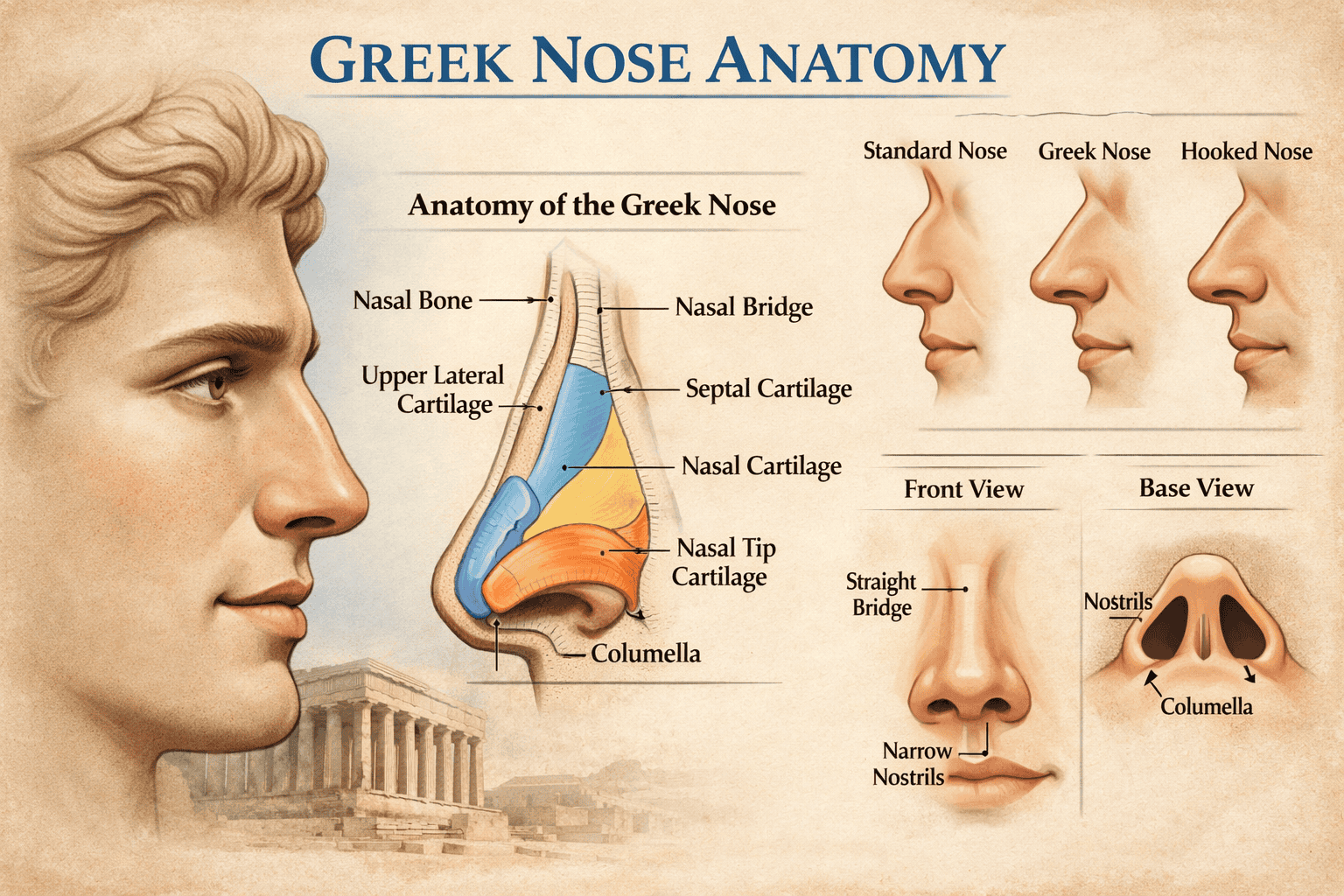
The anatomy of greek nose shape

The Historical and Aesthetic Appeal of the Greek Nose

The Greek nose gained its reputation largely through ancient Greek art and sculpture, where gods, athletes, and philosophers were depicted with straight, harmonious nasal profiles. In classical aesthetics, this nose was seen as a symbol of:

  • Balance and proportion

  • Rational beauty

  • Strength and refinement

Modern facial analysis still values these same principles. A straight nasal dorsum often aligns well with the “golden ratio” concepts used in aesthetic medicine today.

Is the Greek Nose Considered Attractive Today?

Yes—but beauty standards have evolved. While the Greek nose is still widely regarded as elegant and timeless, modern aesthetics favor individuality and facial harmony over one universal ideal. Many patients today do not want to “change” a Greek nose, but rather:

  • Refine the nasal tip

  • Adjust projection slightly

  • Improve breathing or function

  • Enhance overall facial balance

This has shifted rhinoplasty goals from transformation to preservation with refinement.

Greek Nose vs. Other Common Nose Shapes

Understanding how the Greek nose differs from other nasal types helps clarify surgical goals and expectations.

Nose Shape Key Difference from Greek Nose
Roman (Aquiline) Prominent dorsal hump
Button Nose Shorter, upturned tip
Nubian Nose Wider base and nostrils
Fleshy Nose Thick skin, rounded tip
Hawk Nose Downward-curving bridge

Unlike hump-based noses, the Greek nose often requires minimal structural alteration, making it ideal for conservative rhinoplasty approaches.

Why Some People with a Greek Nose Consider Rhinoplasty

Despite its aesthetic reputation, not everyone with a Greek nose feels fully confident about their appearance or nasal function. Common motivations for rhinoplasty include:

Aesthetic Reasons

  • Desire for a softer or more delicate look

  • Tip refinement (especially if bulbous or over-projected)

  • Minor asymmetry not visible from the profile

  • Better facial balance in frontal view

Functional Reasons

  • Nasal obstruction or breathing difficulty

  • Septal deviation (can exist even with a straight bridge)

  • History of trauma altering nasal alignment

Importantly, rhinoplasty for a Greek nose is usually conservative, focusing on subtle refinement rather than dramatic reshaping.
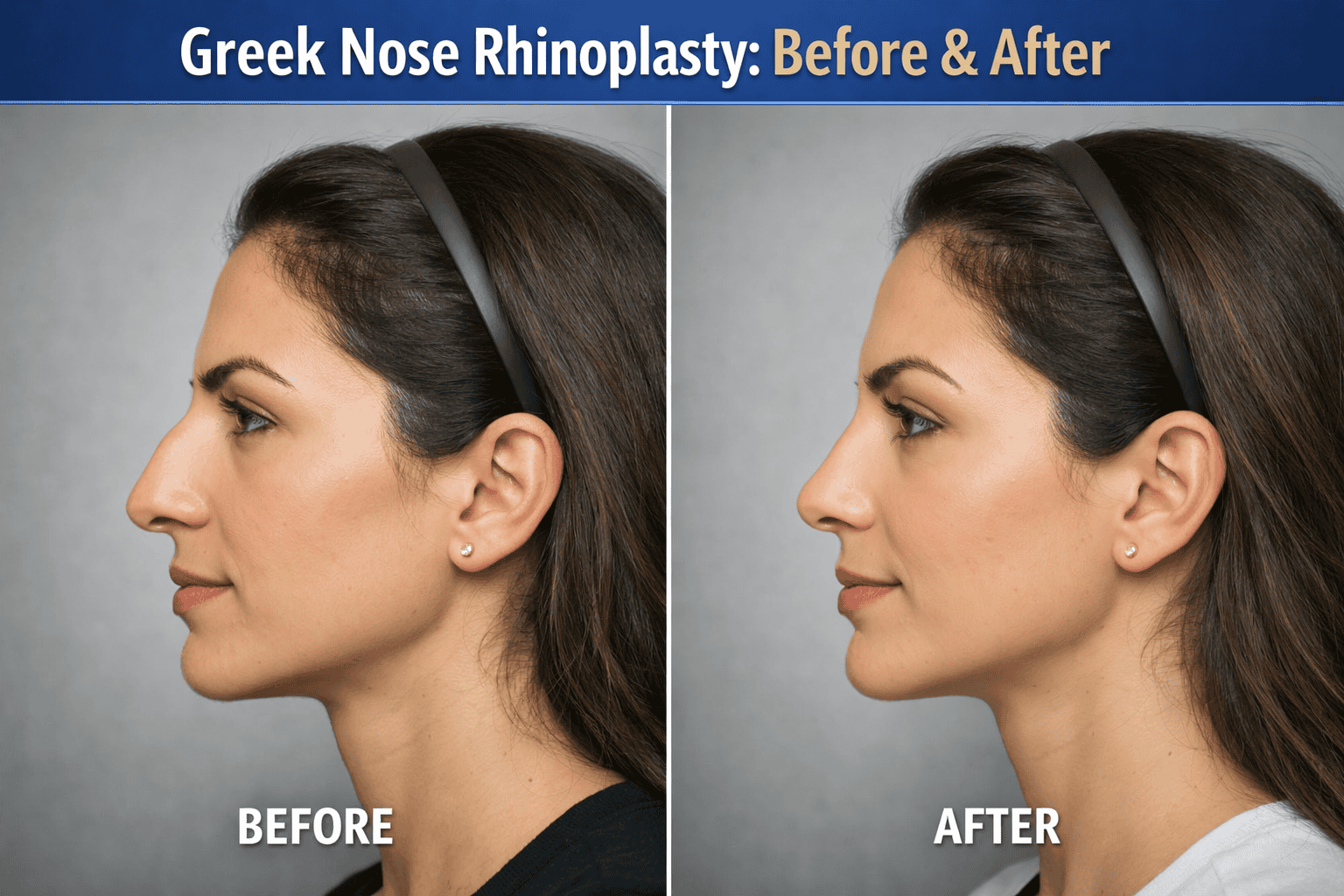
Greek nose rhinoplasty before after

Modern Philosophy: Preserving the Greek Nose

One of the most important principles in modern rhinoplasty is respecting natural anatomy and ethnic identity. Surgeons increasingly aim to:

  • Preserve the straight dorsum

  • Avoid over-reduction

  • Maintain strong structural support

  • Achieve long-term functional stability

Patients seeking surgery are often advised to work with surgeons experienced in ethnic and preservation rhinoplasty, especially when dealing with naturally balanced nose shapes like the Greek nose.

On platforms like Tabeebo, patients can explore rhinoplasty specialists who focus on natural, anatomy-respecting techniques and compare expertise across regions before making decisions.


Best Rhinoplasty Techniques for a Greek Nose

Because the Greek nose already has a naturally straight and balanced dorsum, rhinoplasty techniques focus on refinement rather than reconstruction. The goal is to preserve the classic profile while enhancing harmony and, when necessary, improving nasal function.

1. Preservation Rhinoplasty (Preferred Technique)

Preservation rhinoplasty is often the best option for Greek noses. Instead of removing the nasal bridge and rebuilding it, the surgeon preserves the natural dorsum and makes adjustments beneath it.

Why it works well for Greek noses:

  • Maintains the straight nasal bridge

  • Reduces risk of overcorrection

  • Produces natural, long-lasting results

  • Less disruption of nasal anatomy

This approach is ideal for patients who want subtle changes without losing their defining features.

2. Tip Refinement Rhinoplasty

In many Greek nose cases, the main concern is not the bridge, but the nasal tip. Tip refinement may include:

  • Improving tip definition

  • Adjusting projection (how far the tip extends)

  • Correcting minor asymmetry

  • Reducing bulbosity while preserving strength

Surgeons often use cartilage-sparing sutures rather than aggressive excision to maintain long-term stability.

3. Functional Rhinoplasty (If Breathing Is Affected)

Even with a straight external appearance, some patients have internal issues such as:

  • Septal deviation

  • Narrow internal nasal valves

  • Turbinate hypertrophy

Functional rhinoplasty addresses these problems while preserving the external Greek profile. This combination of aesthetic and functional correction is common and highly effective.

Open vs. Closed Rhinoplasty for a Greek Nose

Approach When It’s Used Benefits
Closed Rhinoplasty Minor refinements No visible scar, faster recovery
Open Rhinoplasty Complex tip work or asymmetry Better visibility and precision

For many Greek nose patients, closed rhinoplasty is sufficient, but the final decision depends on anatomy and surgical goals.

What Results Can Patients Expect?

Patients with a Greek nose usually experience:

  • Subtle yet noticeable refinement

  • Preserved straight profile

  • Improved facial balance

  • Natural-looking results even in close-up views

Because the changes are conservative, satisfaction rates are generally very high, especially when expectations are realistic and well discussed.

Recovery Timeline

  • First week: Swelling and mild bruising

  • 2–3 weeks: Most visible swelling subsides

  • 3 months: Nose looks more refined

  • 6–12 months: Final results fully settle

Greek nose rhinoplasty often involves less swelling than more extensive procedures because fewer structural changes are made.

Choosing the Right Rhinoplasty Surgeon

The most important factor in Greek nose rhinoplasty is surgeon experience with preservation and ethnic rhinoplasty techniques. Patients should look for:

  • Board-certified plastic or ENT surgeons

  • Experience with natural, conservative rhinoplasty

  • Before-and-after cases of straight-nose refinement

  • Clear discussion of realistic outcomes

On Tabeebo, patients can explore and compare rhinoplasty specialists, review credentials, and learn about different surgical approaches before choosing a provider.


Frequently Asked Questions (FAQs)

1. Is a Greek nose considered ideal for rhinoplasty?

A Greek nose is often ideal for conservative rhinoplasty, as it already has a balanced structure that can be refined rather than changed dramatically.

2. Can rhinoplasty ruin the natural Greek nose shape?

When performed improperly, yes. That’s why preservation techniques and experienced surgeons are critical.

3. Does a Greek nose need surgery at all?

Not necessarily. Many people choose rhinoplasty only for functional issues or minor refinements, not cosmetic correction.

4. Is preservation rhinoplasty permanent?

Yes. When done correctly, results are long-lasting and structurally stable.

5. How do I know if I’m a good candidate?

A consultation with a qualified rhinoplasty surgeon is essential to assess anatomy, expectations, and functional needs.


References

  1. American Society of Plastic Surgeons (ASPS) – Rhinoplasty Overview
    https://www.plasticsurgery.org

  2. Rohrich RJ et al. Preservation Rhinoplasty Concepts. Plastic and Reconstructive Surgery Journal.

  3. PubMed – Nasal Anatomy and Aesthetic Analysis
    https://pubmed.ncbi.nlm.nih.gov

  4. Farkas LG. Anthropometry of the Head and Face. Raven Press.

Send a Review

Your rate *