
7 Best Alternatives to Dental Implants (Pros, Cons & Cost Comparison Guide)
Dental implants are often considered the gold standard for replacing missing teeth. They are durable, stable, and natural-looking. However, not […]
Introduction For many women and couples trying to conceive, In Vitro Fertilization (IVF) is one of the most promising fertility […]

For many women and couples trying to conceive, In Vitro Fertilization (IVF) is one of the most promising fertility treatments available today. But one factor influences IVF success more than almost anything else: age.
Whether you are in your early 30s, late 30s, or entering your 40s, understanding how age affects IVF success rates can help you plan realistically, emotionally, and financially.
This detailed guide explains IVF success rates by age, why fertility changes over time, what women can do to improve their chances, and how new technologies are helping women conceive later in life.
A woman’s age influences both:
the quality of her eggs, and
the number of eggs remaining
Women are born with around 1–2 million eggs, but by puberty that number falls to about 300,000. Throughout a woman’s life, this reserve continues to decline, and the quality of chromosomes inside the eggs also changes.
As age increases:
Egg quality declines
Chromosomal abnormalities increase
Embryo implantation becomes more difficult
Miscarriage risk increases
This is why age is one of the strongest predictors of IVF success.
External medical reference:
American Society for Reproductive Medicine (ASRM) – Age and Fertility
https://www.asrm.org
Although success rates vary by clinic and individual health factors, global studies—including data from the CDC, ESHRE, and major fertility centers—show clear trends.

Women under 35 generally have the highest success because they still produce high-quality eggs.
Fresh or frozen IVF cycle success: 45–55% per cycle
Implantation rate: High
Miscarriage risk: Low
Most clinics consider this the most favorable age group for IVF.
Egg quality begins to decline gradually after age 35.
Success rate per cycle: 35–45%
More cycles may be needed
Slight increase in miscarriage risk
Women in this range still maintain a strong chance of success, especially with good ovarian reserve.
This age group shows a significant drop in ovarian reserve and egg quality.
Success rate per cycle: 20–30%
Increased chromosomal abnormalities
More common use of ICSI or PGT-A
Multiple cycles often needed
Clinics typically recommend faster treatment planning and egg freezing if delaying fertility.
Fertility declines steeply after the age of 40.
Success rate per cycle: 10–20%
High miscarriage rate (up to 30–40%)
PGT-A recommended to select normal embryos
Women in this group may require more aggressive treatment or consider donor eggs.
Natural egg quality declines sharply, making implantation difficult.
Success rate using own eggs: 3–7%
Success using donor eggs: 50–70%
Many clinics internationally recommend using donor eggs after age 43–45 due to extremely low natural success.
Age affects not only success but the risk of miscarriage:

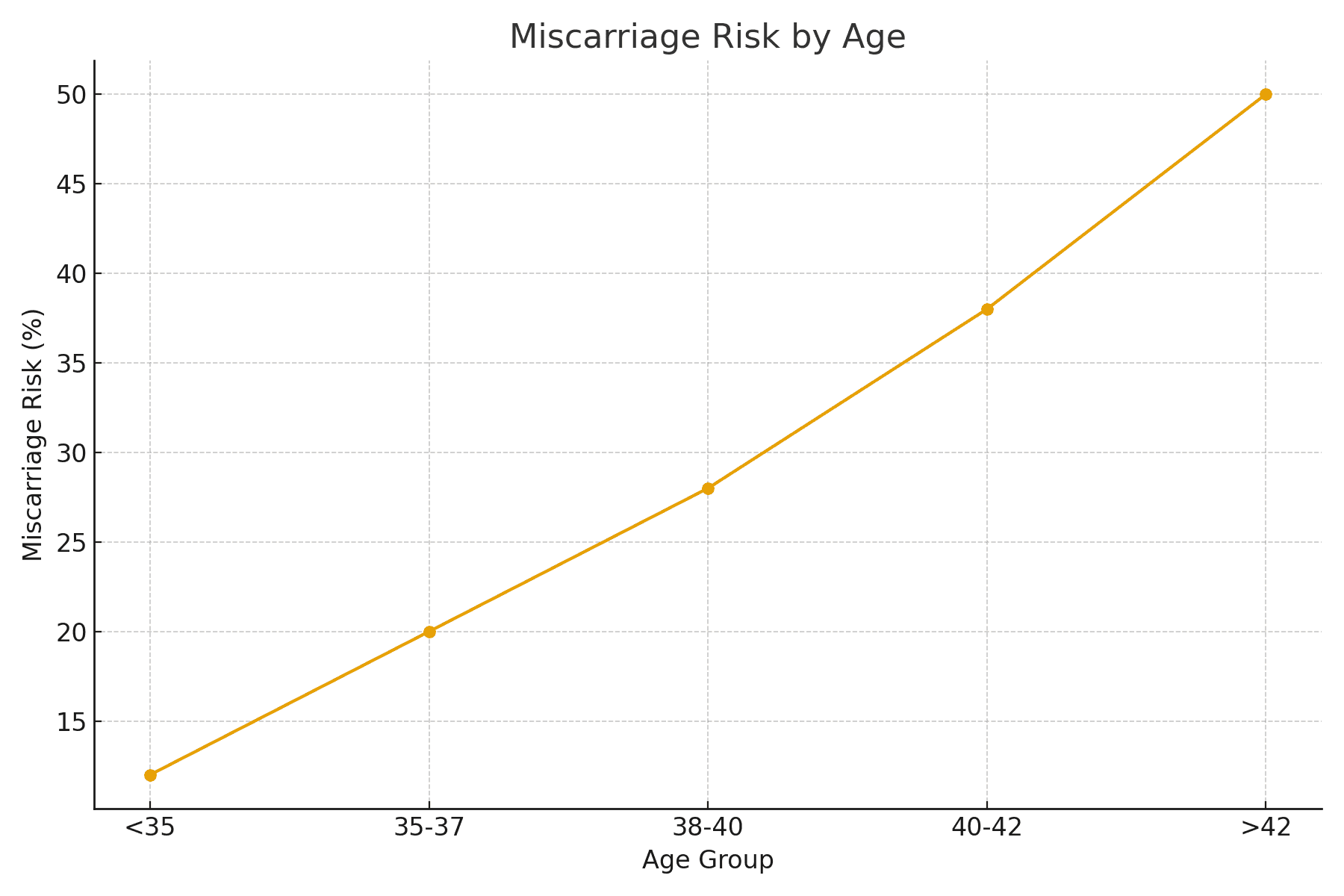
This is due to increasing chromosomal abnormalities in eggs.
Before beginning IVF, most clinics perform fertility assessment tests to determine a woman’s ovarian reserve.
Indicates egg reserve
Higher AMH = better response to stimulation
Low AMH predicts lower IVF success
Measured by ultrasound
More follicles = more eggs available for retrieval
Elevated FSH often indicates reduced ovarian reserve.
Women with lower AMH or AFC may still conceive through IVF, but may need higher doses of medication or more cycles.
Although age is the most influential variable, several lifestyle and medical factors can significantly increase success rates:
Maintain a healthy weight
Reduce sugar and processed food
Avoid smoking and alcohol
Increase intake of antioxidants (vitamin C, E, omega-3, CoQ10)
Manage stress levels
Research has shown that supplements like CoQ10 support mitochondrial function and may increase egg quality in older women.
Reference: Fertility & Sterility Journal
Helps when fertilization is a concern.
Identifies healthy embryos and increases implantation chances.
More reliable than day-3 embryo transfer.
Allows embryologists to select the most viable embryos.
This is especially important for women over 38.
Clinics in Turkey, Iran, UAE, Cyprus, and the Czech Republic often offer high success at a lower cost.
You can compare verified fertility specialists and clinics through Tabeebo.
Although some women get pregnant on the first cycle, the cumulative success rate rises significantly when multiple cycles are used.

1–2 cycles often enough
2–3 cycles recommended
3–4 cycles may be needed
3–6 cycles
Consider donor eggs for faster success
Best results with donor eggs
Natural eggs success extremely low
Egg freezing (oocyte cryopreservation) is one of the most effective ways to preserve fertility.
Under 35 — highest egg quality
35–37 — still good
Over 38 — still helpful but with lower success
Egg freezing has allowed many women to delay pregnancy while maintaining high success potential in later IVF cycles.
A key benefit of donor eggs is that success depends on the donor’s age, not the mother’s.
50–70% per cycle, regardless of recipient age
This makes donor eggs an excellent option for women in their 40s or those with low egg quality.
IVF is not just a medical journey; it is an emotional one.
Stress from cycle monitoring
Fear of failure or miscarriage
Hormonal side effects
Pressure from family or society
IVF costs vary widely:
USA: $15,000–$25,000
Europe: €4,000–€8,000
Middle East: $1,500–$5,000
Women should be prepared for the possibility of multiple cycles.
To read more about IVF costs in the Middle East (Turkey, Iran and UAE) you can click here.
IVF may be recommended earlier if:
AMH or AFC is low
You have irregular cycles
You have endometriosis
You have blocked fallopian tubes
You or your partner has severe infertility
You are above 37 and trying for >6 months
Seeing a specialist early improves overall success.
Age plays a central role in IVF success, shaping egg quality, embryo health, miscarriage risk, and the number of cycles needed.
While women under 35 have the highest chances, women in their late 30s and early 40s can still achieve pregnancy through advanced IVF technologies, egg freezing, lifestyle optimization, and, when needed, donor eggs.
Understanding your fertility profile early—through AMH, AFC, and FSH tests—helps you make informed decisions and plan the path that works best for you.
For women planning IVF, especially those over 35, consulting with experienced fertility specialists is essential. Platforms like Tabeebo can connect you with verified IVF clinics and reproductive endocrinologists across countries with high success rates.
Dental implants are often considered the gold standard for replacing missing teeth. They are durable, stable, and natural-looking. However, not […]

A bulbous nasal tip is one of the most frequent concerns among rhinoplasty patients—and one of the most misunderstood. Unlike […]

An upturned nose, often referred to as a celestial nose, is one of the most recognizable and debated nasal shapes […]

The Roman nose—also known as the aquiline nose—is one of the most recognizable and historically significant nose shapes. Characterized by […]

A fleshy nose is one of the most misunderstood nose types in facial aesthetics. Many people with this nasal structure […]

The Greek nose is one of the most recognizable and historically admired nose shapes in the world. Often associated with […]
Summary
