A button nose is commonly described as a relatively small nose with a soft, rounded tip and, in many people, a subtle upward rotation. The combination can create a compact appearance that is sometimes associated with youthful or delicate facial features.
However, “button nose” is an everyday aesthetic description rather than a formal medical diagnosis. Two people described as having button noses may have very different nasal bridges, tip projection, nostril widths, skin thicknesses, and facial proportions.
That distinction matters—especially when discussing cosmetic treatments. A nose that looks balanced on one face may not have the same effect on another, and modern rhinoplasty focuses increasingly on facial harmony and nasal function rather than reproducing one fashionable nose shape for everyone.
This guide explains what a button nose looks like, what influences the shape of the nose, how it differs from an upturned or celestial nose, and what makeup, dermal fillers and rhinoplasty can realistically change.
What Does a Button Nose Look Like?
There is no single medical definition that determines whether someone has a button nose. In everyday use, the button nose shape usually combines several visual characteristics:
- A relatively short or compact appearance
- A softly rounded nasal tip
- Mild upward rotation of the tip in some people
- A relatively smooth bridge
- Gentle rather than sharply defined contours
- Proportions that make the nose appear small relative to the rest of the face
Not every button nose has all of these characteristics.
For example, one person may have a rounded tip with very little upward rotation, while another may have a more visibly elevated tip with greater nostril visibility.
From an anatomical perspective, doctors describe the nose more precisely by evaluating structures such as the nasal root, bridge, tip, columella, alae and nostrils. The NIH guide to nasal anatomy provides a useful medical overview of these anatomical landmarks.
These structures—and their relationship to one another—produce the appearance people informally describe as different nose shapes.
What Does “Button Nose” Mean?
The term comes from the impression of a small, rounded nasal tip that resembles the smooth shape of a button.
It is important to understand that button nose is a descriptive term rather than an official clinical diagnosis.
During a professional nasal assessment, a surgeon would normally evaluate characteristics such as:
- Nasal length
- Bridge height
- Bridge contour
- Tip width
- Tip projection
- Tip rotation
- Nostril shape and visibility
- Skin thickness
- Cartilage strength
- Facial proportions
- Nasal breathing
Looking at these individual characteristics is more useful than trying to place every nose into a single category.
If you are interested in how button noses compare with other nasal forms, Tabeebo’s guide to different nose shapes across ethnicities provides a broader overview of common nose shapes and anatomical variation.
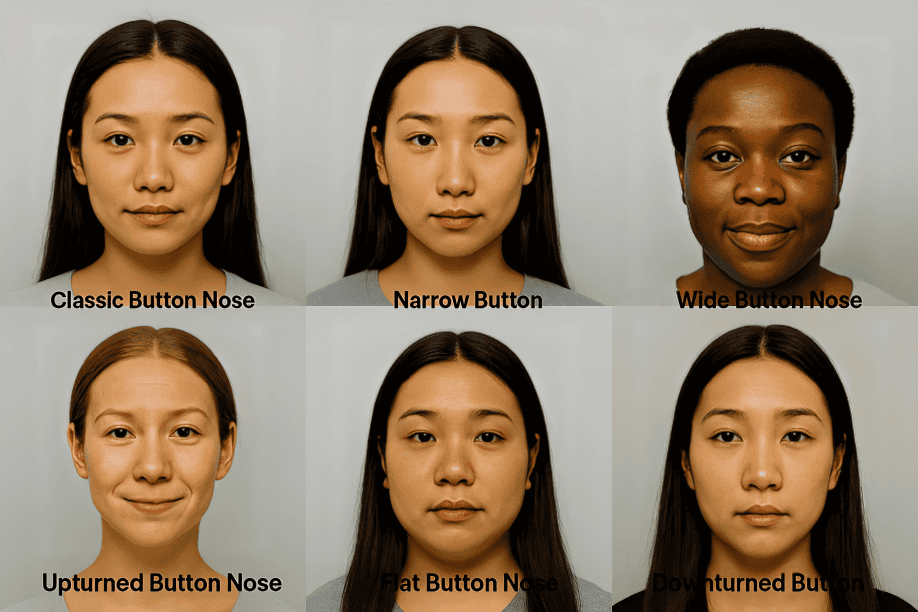
Common Variations in Button-Nose Appearance
You may see websites describing “classic,” “wide,” “narrow” or “flat” button noses as if they were established medical categories. They are better understood as descriptive variations, not formal clinical types.
A button-like appearance can occur with different combinations of anatomy.
Rounded Button Nose
Here, the rounded nasal tip is the dominant feature. The nose may be small or medium in size, and the tip does not necessarily turn upward significantly.
Slightly Upturned Button Nose
In this variation, the rounded tip has noticeable upward rotation. Depending on the degree of rotation, part of the nostrils may be visible from the front.
Narrow Button-Like Nose
Some people have a compact nose with a relatively narrow bridge and softly defined tip. The overall effect may still be described as button-like even when the tip itself is not particularly wide.
Broader Button-Like Nose
A rounded tip can also occur with a wider nasal base or broader nostrils. A broader nose is therefore not automatically inconsistent with a button-like appearance.
These differences illustrate why nose shape is a spectrum rather than a collection of fixed categories.
For a broader look at how nasal features vary, see Tabeebo’s guide to different nose shapes across ethnicities.
Button Nose vs. Upturned Nose: Are They the Same?
The terms button nose, upturned nose, snub nose and celestial nose are sometimes used interchangeably online, but their meanings can overlap without being identical.
A button nose is usually defined mainly by its compact appearance and rounded tip.
An upturned nose is defined more specifically by nasal tip rotation—the tip points upward to a noticeable degree.
A celestial nose is another aesthetic term commonly used to describe a gently upturned nose, particularly when the rotation produces a soft, refined profile.
Therefore:
A button nose can be upturned, but not every upturned nose necessarily has a button-like shape.
Similarly, someone may have a small rounded tip without enough upward rotation to describe the nose as strongly upturned.
For a detailed comparison, read Tabeebo’s guide to the upturned or celestial nose.
Button Nose vs. Bulbous Nose
Button noses and bulbous noses may both appear rounded at the tip, which sometimes causes confusion.
The difference is usually in the proportions and definition of the nasal tip.
A button nose generally appears compact and softly rounded, whereas a bulbous nasal tip may appear:
- Wider
- More prominent
- Less defined
- Disproportionately rounded compared with the nasal bridge
A bulbous appearance can be influenced by cartilage shape, skin thickness, soft tissue and the structural support of the nasal tip.
If the distinction is relevant to you, Tabeebo’s detailed guide to bulbous nose rhinoplasty and nasal-tip refinement explains these differences in greater depth.
Is a Button Nose Genetic?
Genetics plays an important role in facial development, including the size and shape of the nose.
Research into human facial morphology has identified multiple genetic regions associated with variations in features such as nasal width, nasal root, nose shape and other aspects of facial structure.
This means there is no single “button nose gene.”
Instead, the appearance of the nose develops through the interaction of many genes, growth patterns and other biological influences.
It is common to see similarities in nose shape among parents, children and siblings, but inheritance does not produce exact copies. Even close relatives can have noticeably different nasal proportions.
Where Do Button Noses Come From?
People sometimes ask whether button noses belong to a particular ethnicity or geographic population.
There is no single ethnic group that “owns” the button nose.
Nasal morphology varies between individuals and populations, and characteristics such as nasal width, bridge height, projection and tip shape can occur in many different combinations.
Population ancestry can influence average facial characteristics, but there is substantial variation within every population. For this reason, it is more accurate to discuss individual anatomy and population-level variation than to claim that one specific nose shape belongs exclusively to one ethnicity.
Is a Button Nose Attractive?
There is no scientific rule stating that a button nose—or any other nose shape—is inherently more attractive.
Attractiveness is influenced by personal preference, culture, fashion, media exposure and the relationship between different facial features.
Button noses are often represented in popular culture as youthful or delicate. Their contemporary visibility may also be reinforced by:
- Film and television
- Fashion imagery
- Social media
- Beauty filters
- Celebrity culture
- Cosmetic-surgery trends
But facial aesthetics cannot be reduced to the nose alone.
A nose that complements the eyes, lips, cheekbones, forehead and chin may appear harmonious even if it does not match a currently fashionable shape.
This is also why experienced facial plastic surgeons generally evaluate proportion and balance rather than trying to reproduce an identical nose on every patient.

Why Has the Button Nose Become So Popular?
Beauty preferences have changed repeatedly throughout history. Prominent, straight, aquiline, small and upturned noses have all been admired in different cultures and periods.
Today’s interest in the button nose is likely influenced by several factors.
Social Media and Beauty Filters
Images can now circulate globally within hours. Filters and editing tools may also narrow the range of facial features people repeatedly see online.
As a result, certain aesthetic characteristics can become highly visible even when they do not reflect the full diversity of natural human faces.
The Preference for Subtle Cosmetic Results
Modern cosmetic surgery has also moved away from some of the highly standardized results seen in earlier periods.
Many patients now request a nose that appears refined but natural, maintains their identity and remains proportional to the rest of the face.
For some faces, a softly rounded or mildly elevated tip may contribute to that effect. For others, preserving a stronger, straighter or more projected nose may produce better balance.
Celebrity and Influencer Culture
Public figures inevitably influence beauty conversations, but photographs should not be used to diagnose someone’s anatomy or assume they have undergone cosmetic surgery.
Rather than trying to reproduce a celebrity’s nose, patients considering rhinoplasty should discuss the features they like with a qualified surgeon and determine whether those characteristics are realistic for their own anatomy.

Can Makeup Make Your Nose Look More Button-Shaped?
Makeup cannot alter nasal anatomy, but contouring can change how the nose appears in photographs or under certain lighting.
Common techniques include:
- Applying subtle shading along the sides of the bridge
- Using highlight strategically along the center
- Contouring around the tip
- Avoiding excessively dark lines that make contouring obvious
The result depends greatly on lighting, photography and facial structure.
Makeup is therefore best understood as an optical effect, not a structural change.
Can Dermal Filler Create a Button Nose?
Dermal fillers can alter nasal contours in selected patients, a procedure often called nonsurgical rhinoplasty or liquid rhinoplasty.
Filler may sometimes be used to:
- Camouflage a small dorsal irregularity
- Create the appearance of a straighter bridge
- Improve selected asymmetries
- Alter the visual relationship between the bridge and tip
However, filler works primarily by adding volume.
It cannot remove bone or cartilage, permanently shorten a nose or physically make a large nose smaller.
Cleveland Clinic’s overview of nonsurgical rhinoplasty explains the uses and limitations of this procedure.
Is Nonsurgical Rhinoplasty Risk-Free?
No.
Although nonsurgical rhinoplasty does not involve an operation, the nose has a complex blood supply and filler injection in this area requires particular expertise.
Possible complications include swelling, infection, vascular problems and tissue injury. Rare but serious complications can include tissue necrosis and visual impairment.
For this reason, nasal filler should be performed only after appropriate medical assessment by a qualified clinician with detailed knowledge of facial vascular anatomy and the ability to manage complications.
Temporary treatment should not automatically be considered the safer or simpler choice merely because it does not involve surgery.
Can Rhinoplasty Create a Button Nose?
Rhinoplasty is surgery that changes the shape, size or proportions of the nose. It may be performed for cosmetic reasons, functional concerns such as impaired breathing, reconstructive purposes, or a combination of these goals.
For a person who wants characteristics associated with a button nose, a surgeon may evaluate whether changing features such as the following would improve facial harmony:
- Nasal length
- Tip rotation
- Tip projection
- Tip definition
- Bridge height or contour
- Nasal width
- Nostril relationships
The exact surgical plan depends on the patient’s existing anatomy.
Someone with a long nose and drooping tip requires a completely different treatment plan from a person with thick nasal skin, a broad tip or an already short and highly rotated nose.
The Mayo Clinic overview of rhinoplasty also emphasizes that the procedure must be planned around the individual’s anatomy and treatment goals.
The Goal Should Be Balance, Not a Template
Trying to create an extremely short or excessively upturned nose can produce an unnatural appearance and may compromise structural support.
A surgeon normally considers factors such as:
- Facial proportions
- Skin thickness
- Cartilage strength
- Nasal breathing
- Existing nasal anatomy
- Previous surgery or trauma
- Patient expectations
The most successful result is therefore not necessarily the smallest or most “button-like” nose.
It is a nose that works naturally with the rest of the face while preserving appropriate nasal function.
Thinking About Rhinoplasty?
If you are reading about button noses because you are considering changing the shape of your own nose, the next useful step is not choosing a nose shape from a photograph. It is understanding which changes are realistic for your individual anatomy.
Tabeebo allows you to explore rhinoplasty specialists and compare provider profiles, including doctors in different countries and cities, before deciding whom you would like to contact.
How Long Does Rhinoplasty Take to Heal?
Rhinoplasty produces long-lasting structural changes, but healing happens gradually.
During the early recovery period, patients may experience:
- Swelling
- Bruising
- Temporary nasal congestion
- Tenderness
Much of the visible early swelling usually improves during the first few weeks.
However, this does not mean that the final result is visible immediately.
The nasal tip in particular can continue to refine for months. According to the American Society of Plastic Surgeons’ rhinoplasty recovery guidance, it may take up to a year for the new nasal contour to fully refine.
Recovery varies according to the operation performed and the individual patient’s healing characteristics.
Risks and Limitations of Rhinoplasty
Like all surgical procedures, rhinoplasty carries potential risks.
These may include:
- Bleeding
- Infection
- Changes in sensation
- Scarring
- Breathing difficulties
- Poor wound healing
- Persistent swelling
- Nasal asymmetry
- Septal complications
- Unsatisfactory appearance
- Need for revision surgery
The American Society of Plastic Surgeons provides additional information about rhinoplasty risks and safety.
There is also an important aesthetic limitation.
Not every face benefits from an extremely small or highly upturned nose.
Reducing the nasal framework too aggressively or rotating the tip excessively can create an unnatural appearance and potentially affect function.
This is why the consultation should focus on what can realistically and safely be achieved with your anatomy rather than simply copying another person’s nose.
How to Choose the Right Rhinoplasty Surgeon
If you are considering surgery, choosing an appropriately qualified and experienced surgeon is one of the most important decisions you will make.
Check Professional Qualifications
Review the doctor’s:
- Medical license
- Relevant surgical specialty
- Training
- Professional credentials
- Clinical experience
Look for Specific Rhinoplasty Experience
Nasal surgery is technically complex.
A surgeon who frequently performs rhinoplasty may have more experience managing different combinations of cartilage, skin thickness, tip anatomy and functional problems.
Review More Than One Before-and-After Result
Do not judge a surgeon from one dramatic photograph.
Look at multiple patients and consider whether the results:
- Look proportional
- Appear natural
- Suit different facial types
- Remain consistent from different angles
Consider Nasal Function as Well as Appearance
Aesthetic changes should not be planned independently from breathing.
A proper assessment may need to consider:
- The septum
- Nasal airway
- Previous trauma
- Previous surgery
- Breathing problems
Discuss Expectations Clearly
A responsible surgeon should explain:
- What can realistically be changed
- Which features should probably be preserved
- Potential complications
- Recovery expectations
- Possibility of revision
- How the proposed changes may affect facial balance
If you have reached the stage where you want to compare doctors rather than simply learn about the procedure, you can browse Tabeebo’s rhinoplasty specialists and use the available filters to explore providers by location and other profile information.
Should You Change a Naturally Button-Shaped Nose?
Not necessarily.
A button nose is a natural variation in facial anatomy—not a disease or medical problem.
Some people actively want a smaller or more upturned nose. Others who naturally have short or upturned noses may prefer:
- Greater nasal length
- Less nostril visibility
- Different tip projection
- A stronger bridge
Neither preference makes one type of nose objectively better.
Cosmetic treatment should be based on personal goals and realistic expectations rather than pressure from social media, beauty trends or other people’s opinions.
If you also experience breathing difficulties, previous nasal trauma or other functional concerns, those symptoms should be discussed with a qualified healthcare professional.
Frequently Asked Questions About Button Noses
What is a button nose?
A button nose is an informal term for a relatively compact nose with a softly rounded tip and sometimes a slight upward rotation. It is an aesthetic description rather than a formal medical classification.
What does a button nose look like from the side?
From the side, a button nose may appear relatively short with a softly rounded tip and mild upward rotation. However, appearance varies because nasal bridge height, projection and tip angle differ between individuals.
Is a button nose the same as an upturned nose?
Not exactly. A button nose is usually identified by its compact appearance and rounded tip, while an upturned nose is defined primarily by increased upward rotation of the tip. The two can overlap.
Is a button nose the same as a celestial nose?
The descriptions can overlap, especially when a button nose is slightly upturned. However, “celestial nose” generally emphasizes upward tip rotation, while “button nose” emphasizes a compact, rounded appearance.
Is a button nose genetic?
Genetics contributes significantly to facial and nasal morphology, although there is no single gene responsible for a button nose. Many genetic and developmental factors influence nose shape.
Where are button noses most common?
Button-like characteristics occur across many populations. Although average nasal anatomy can vary among populations, the term should not be assigned exclusively to one ethnicity.
Is a button nose attractive?
That depends on individual preference. Attractiveness is subjective and influenced by facial proportion, culture, personal taste and changing beauty standards.
Is a button nose rare?
There is no reliable prevalence figure because “button nose” is not a standardized medical classification and its definition varies.
Can filler make your nose smaller?
Filler cannot physically remove nasal tissue because it adds material. In selected cases it can change contours and make the overall profile appear more balanced.
Can rhinoplasty give you a button nose?
Rhinoplasty can modify characteristics associated with a button nose, including nasal length, tip shape, rotation and projection. Whether these changes are appropriate depends on the patient’s anatomy and facial proportions.
How long does rhinoplasty take to heal?
Much of the initial bruising and swelling improves during the first several weeks, but refinement continues for months. In some patients, the final nasal contour may take up to a year to become fully apparent.
Final Thoughts
The button nose is one of many naturally occurring nasal shapes. Its recognizable features—usually a compact appearance, rounded tip and sometimes mild upward rotation—have made it a frequent subject of beauty and cosmetic-surgery discussions.
But there is no universal “ideal” nose.
The most appropriate nasal shape depends on the person’s natural anatomy, facial proportions, functional needs and personal preferences.
If you are simply exploring nose shapes, you may want to continue with Tabeebo’s guides to different nose shapes, the upturned or celestial nose or bulbous nasal tips.
If your interest has moved beyond research and you are considering rhinoplasty, the next step is to compare appropriately qualified providers and discuss what is realistic for your own anatomy.
Explore rhinoplasty specialists on Tabeebo →
This article is intended for general educational purposes and does not replace individual medical advice, diagnosis or treatment.